Best Mobile Gaming Trends Shaping the Industry Today
Mobile gaming has moved far beyond simple puzzle games played during a commute. Today, smartphones can deliver competitive shooters, large strategy games, multiplayer RPGs, social experiences, and visually impressive titles that once would have required a console.
That evolution is changing what players expect from their games. Fast updates, regular events, social features, smoother graphics, and the ability to continue playing across devices are increasingly becoming part of the experience.
For anyone following the Best Mobile Gaming trends, the most interesting story is not simply that mobile games are becoming bigger. The industry is also becoming smarter about engagement, monetisation, technology, and player communities. Sensor Tower reported that mobile gaming in 2024 saw in-app purchase revenue rise 4%, while time spent increased 7.9% and sessions climbed 12%.
1. Mobile Games Are Becoming Long-Term Services
One of the biggest changes in mobile gaming is the shift from launching a finished game to operating a constantly evolving service.
Developers increasingly use LiveOps to introduce seasonal events, limited-time challenges, new characters, rewards, tournaments, and themed updates. Instead of completing a game and moving on, players are given new reasons to return every week or month.
Unity has highlighted the growing importance of LiveOps as studios look for stronger engagement after launch. Its gaming reports show developers placing greater emphasis on expanding player functionality and improving ongoing game operations.
This model works because mobile players usually have many games competing for their attention. Regular content keeps an established game feeling fresh without requiring developers to release an entirely new title.
2. Hybrid Monetisation Is Becoming the New Normal
Mobile developers once tended to choose one primary business model. Casual games relied heavily on advertising, while strategy games and RPGs often focused on in-app purchases.
That division is becoming less obvious.
Hybrid monetisation combines several revenue streams, such as rewarded video ads, optional purchases, battle passes, subscriptions, and premium bundles. AppsFlyer reports that hybrid approaches are spreading across gaming categories as developers combine advertising and purchase revenue.
The goal is not simply to show more advertisements. Smart monetisation gives different types of players different choices.
Someone who never spends money might watch a rewarded video for an extra life. Another player might purchase cosmetics, while a highly engaged user may buy a season pass.
Done properly, the system can generate revenue without making every player feel pressured to pay.
3. Cross-Platform Gaming Is Breaking Down Device Barriers
Mobile gaming is also becoming less isolated from PC and console gaming.
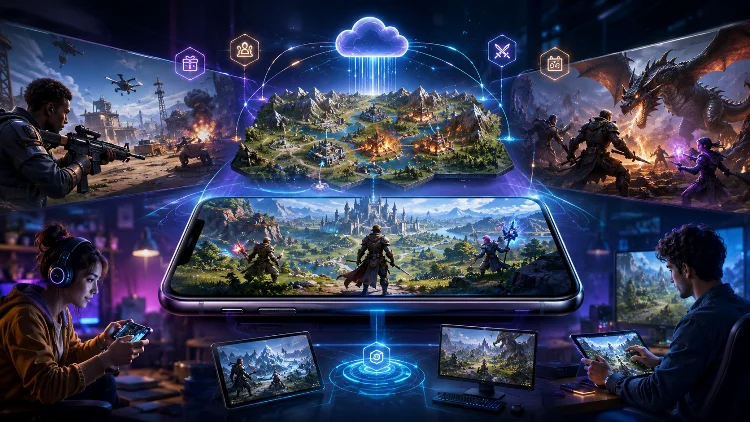
Players increasingly expect their accounts, progress, achievements, and purchases to follow them across devices. A game might begin on a smartphone during the day and continue on a laptop later.
Google has expanded this idea significantly through Google Play Games on PC. By late 2025, Google said the service had moved from beta to general availability, expanding its effort to connect mobile and PC gaming experiences.
Apple is moving in a similar direction through its unified gaming ecosystem and Apple Games app, which brings game discovery, achievements, activities, and social features into one destination.
For developers, cross-device support can extend a game’s lifespan. For players, it simply makes gaming more convenient.
4. Mobile Graphics Keep Getting Closer to Console Quality
Smartphone hardware is improving quickly, and game engines are taking advantage of it.
Modern devices can handle advanced lighting, high-resolution textures, complex environments, and fast multiplayer action. Google has also made Vulkan its official graphics API direction for Android while expanding tools designed to maintain smoother performance during longer gaming sessions.
Performance optimisation is especially important on mobile because developers must balance graphics with heat, battery consumption, and hardware differences.
The Best Mobile Gaming experiences therefore are not always the games with the most realistic graphics. Successful titles usually balance visual quality with stable frame rates, quick loading times, and efficient power usage.
5. Social Gaming Is Becoming More Important
Mobile gaming is increasingly something people do together.
Friend systems, clans, guilds, cooperative missions, leaderboards, multiplayer matchmaking, and community competitions are now common across many genres.
Even games that were traditionally designed as single-player experiences are adding social layers.
Apple’s Game Center, for example, supports achievements, leaderboards, multiplayer matchmaking, real-time play, and friend connections across Apple devices.
These features matter because social connections create another reason to return. A player may lose interest in a repetitive mission but still log in because friends are waiting for them.
Community can therefore become just as important as gameplay itself.
6. AI Is Influencing Development and Marketing
Artificial intelligence is also entering the mobile gaming workflow.
Studios are experimenting with AI for concept generation, dialogue drafts, testing, localisation, analytics, advertising creatives, and development assistance. It does not mean that developers are suddenly replacing complete production teams with machines.
Instead, AI is increasingly being used to speed up repetitive tasks and help teams test more ideas.
AppsFlyer’s 2026 gaming marketing research notes that AI has significantly increased the volume of advertising creatives being produced, making competition for player attention even stronger.
That creates an interesting situation: AI makes content creation faster, but it also raises the standard for standing out.
7. Strategy and Hybrid Genres Are Growing More Sophisticated
Genre boundaries are becoming increasingly blurry.
Puzzle games may contain RPG progression. Strategy games may include survival mechanics. Casual games may introduce long-term character systems normally associated with midcore titles.
Sensor Tower’s State of Gaming 2026 report identified strategy as a particularly strong mobile category in 2025, noting that it was the only major genre to increase revenue, downloads, and time spent simultaneously. Titles such as Last War: Survival and Whiteout Survival helped drive that momentum.
This genre blending gives developers more ways to keep players engaged while offering audiences experiences that feel familiar but not completely predictable.
The mobile gaming industry is becoming more sophisticated every year. Better hardware matters, but technology alone is not driving the change. LiveOps, social communities, hybrid monetisation, AI-powered workflows, cross-platform ecosystems, and deeper game design are equally important.
The biggest Best Mobile Gaming trend is ultimately a shift toward longer-lasting experiences rather than disposable apps.
Players now expect games that continuously evolve around them. Developers that can combine strong gameplay with fair monetisation, regular content, reliable performance, and genuine community features will be in the strongest position.
If you follow the gaming industry, keep watching these trends—they are likely to influence not only mobile games, but the wider gaming market as well.