Progressive vs Fixed Jackpots Explained for Beginners
A £5,000 jackpot that never changes and a £1 million jackpot climbing by the minute might both appear under the same “jackpot slots” category. Behind the scenes, though, they can work very differently.
Understanding Progressive vs Fixed Jackpots is useful because the jackpot figure alone tells only part of the story. You also need to consider how the prize is funded, whether it resets after a win, how eligibility works, and how the jackpot fits into the overall mathematics of the game.
There is no automatic “better” option. A progressive jackpot can offer a much larger headline prize, while a fixed jackpot provides a more predictable maximum award.
More importantly, neither format makes random slot outcomes easy to forecast.
Let’s break down the differences without complicated casino jargon.
Fixed Jackpots Keep the Top Prize Consistent
A fixed jackpot is exactly what the name suggests: the jackpot amount is predetermined rather than increasing because more people are playing.
If the advertised top prize is £20,000, the game may continue offering that same jackpot value until its rules or configuration change.
This makes the prize structure easy to understand.
A player does not need to monitor a growing counter or wonder whether playing later could produce a larger advertised jackpot.
The trade-off is that fixed jackpots generally do not produce the huge headline figures associated with networked progressive games.
Still, jackpot size and entertainment value are personal preferences. A smaller fixed top prize does not automatically mean a worse game.
Progressive Jackpots Change With Eligible Play
Progressive prizes are dynamic.
According to the UK Gambling Commission, a progressive jackpot is an incremental prize that increases through contributions from stakes, starting from a preset base value.
Think of it as a prize meter.
The system might begin at £50,000 and gradually move upward as qualifying activity contributes toward the jackpot. When the prize is finally awarded, the system can reset to its starting seed according to the published rules.
Regulated progressive systems in Great Britain must provide information about how the jackpot is funded, the starting seed, applicable limits, and the way prizes are determined.
That transparency is important because progressive systems can be more complex than fixed jackpots.
The Prize Pool Is Where the Biggest Difference Appears
With a fixed jackpot, there is no growing community pool in the same sense.
The advertised prize is simply part of the game’s predetermined payout structure.
Progressive systems introduce another layer. A portion associated with eligible play can contribute to the progressive pool, allowing the jackpot to rise.
This can happen within one game or through broader linked systems, depending on the product design.
The more significant practical difference is that the jackpot’s value can change while you are looking at it.
However, do not confuse the rising amount with rising certainty.
The fact that thousands of people have contributed to a jackpot does not mean the next player must win it.
Jackpot Size and Jackpot Odds Are Not the Same Thing
This is probably the most important point for beginners.
A £1 million jackpot is a description of the potential prize. It is not a statement that the jackpot is close to triggering.
Random game results must follow the mathematical rules of the game. The Gambling Commission requires RNG-driven outcomes within its regulatory scope to be acceptably random, with random inputs mapped to results according to the published probabilities and paytables.
So a progressive prize growing for several weeks does not automatically create a “due” jackpot.
The same principle applies to fixed jackpots.
If the jackpot failed to appear during the previous 1,000 rounds, that history does not by itself guarantee that the next round will win.
Progressive Jackpots Can Have Higher Volatility
Jackpot games can feel dramatically different because of volatility.
The Gambling Commission notes that progressive jackpots often involve large prizes occurring infrequently, giving the jackpot component high volatility characteristics.
This makes intuitive sense.
If a portion of the game’s theoretical prize value is connected to an enormous jackpot that is rarely awarded, ordinary short sessions may look nothing like the mathematical long-term average.
Fixed jackpot games can also be volatile, of course. The label “fixed” says nothing by itself about how often ordinary prizes occur.
Volatility depends on the overall game mathematics, not simply whether the headline jackpot moves.
RTP Needs Context in Jackpot Games
Return to Player is often used when comparing slot games.
The important word is theoretical.
The Gambling Commission explains that RTP describes an average achieved over a significant number of game plays. It is not what every individual player should expect to receive during a session.
Progressive jackpots add another consideration.
The base slot and the progressive prize can represent different components of the overall return. The Commission’s current monitoring guidance says games connected to progressive systems should have the base game measured independently, while the jackpot component can require separate monitoring because of its infrequent, high-value nature.
So comparing two games solely by their headline RTP can miss important context.
Jackpot Eligibility Can Differ Between Games
Not every jackpot necessarily works with every available stake.
A game may set specific qualifying conditions.
The player-facing information should explain whether a particular stake or game configuration qualifies for the progressive prize.
The Gambling Commission’s progressive jackpot standards state that when customers contribute to the pool, they should be eligible to win the jackpot while playing. Where contributions vary, the probability of winning should correlate with the amount contributed.
For beginners, this makes the rules page especially important.
Do not simply increase a bet because you assume that is necessary. Check what the game actually says.
How Jackpot Systems Are Tested
Regulated jackpot systems are not supposed to operate as mysterious black boxes.
In Great Britain’s licensed remote gambling market, independent test houses are used for specified technical requirements. The Gambling Commission states that progressive jackpot testing should verify system design and jackpot-trigger functionality against the intended rules and RTP.
RNG systems are also tested against technical requirements concerning randomness and the mapping of random outputs into game results.
This is one reason the licensing status of a real-money operator matters.
A polished website or large jackpot banner tells you little about whether a gambling business operates under recognised regulatory oversight.
Which Type Is Better for Beginners?
There is no universal winner.
A fixed jackpot is easier to understand because the top prize stays predictable. Some beginners may prefer that simplicity.
Progressive games can provide much larger headline prizes, but those jackpots may also be extremely infrequent and come with more complex rules.
The sensible comparison is not “Which one will make me more money?”
Instead, compare the rules, RTP information, jackpot trigger, eligibility requirements, and stake size you are comfortable using.
Both formats involve chance.
Neither should be approached as a reliable income source.
A Simple Example
Imagine two fictional games.
Game A has a fixed £25,000 jackpot. The value remains the same whenever an eligible player triggers it.
Game B begins with a £100,000 progressive jackpot. Contributions from eligible activity increase the prize until someone wins, after which it resets to the specified seed value.
Game B might eventually display £750,000.
That makes its potential jackpot much larger, but it tells you nothing on its own about whether your next spin has a better chance than it would have when the jackpot showed £100,000.
That distinction is the key to understanding the comparison.
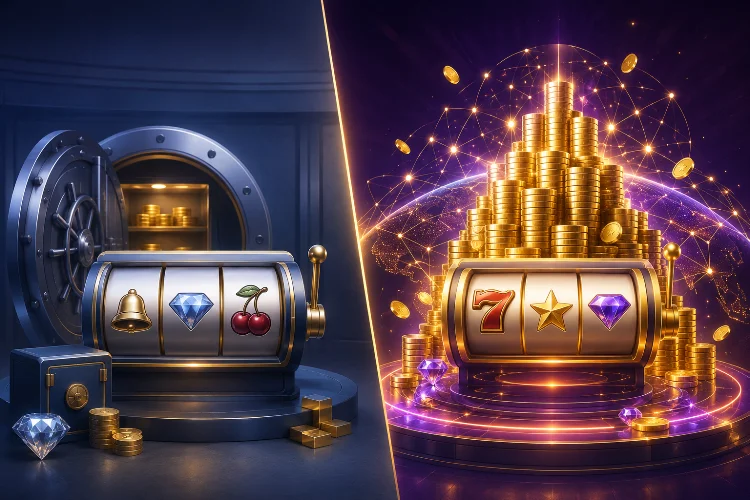
When comparing Progressive vs Fixed Jackpots, the biggest difference is how the prize behaves.
Fixed jackpots offer a predetermined top award. Progressive jackpots begin from a seed value and can increase through contributions associated with eligible play.
From there, other factors matter: RNG mechanics, RTP, volatility, qualification rules, and how the jackpot is triggered.
A progressive jackpot can look more exciting because the prize keeps growing, but a bigger number is not the same as better odds.
Before playing any real-money jackpot game, read its rules, check whether the operator is appropriately licensed in your jurisdiction, understand your eligibility, and choose a spending limit that treats gambling purely as entertainment.